

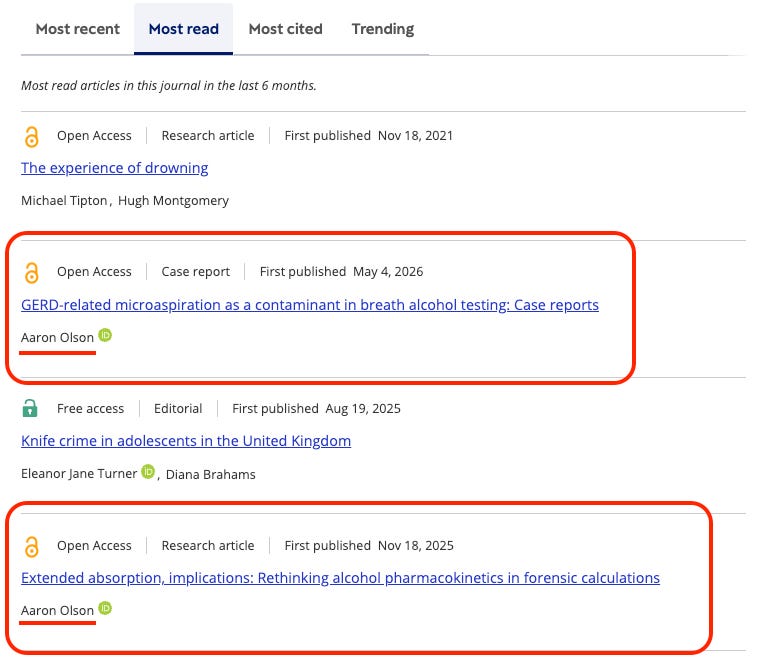
I was happy to see two of my papers make it to the Most Read section of the Medico-Legal Journal. I’m glad people are reading about these topics because they come up in the cases I review.
In one paper, I look at the significance of GERD-related microaspiration and how it might affect a breath test. The other looks at the assumptions made about alcohol absorption and retrograde extrapolation.
Could GERD-related microaspiration affect a breath alcohol sample?
In my 2026 paper, I describe two cases involving people with a history of gastroesophageal reflux disease (GERD) or aerodigestive disorders who coughed multiple times during the pre-test observation period preceding a breath alcohol test. In these cases, the subjects had a history of GERD, and their expirograms showed indications of mouth alcohol contamination.
The cases raised a question for me. Could small amounts of refluxed stomach contents enter the upper airway and contribute to contamination? That process is called microaspiration.
I proposed that the samples in each case may have been contaminated through microaspiration.
Read the open-access paper · GERD-related microaspiration as a contaminant in breath alcohol testing: Case reports
What if alcohol absorption takes longer than two hours to absorb?
My 2025 paper looks at retrograde extrapolation and the assumptions involved in that calculation. Specifically, the reliability of a retrograde calculation depends on whether the person was in the post-absorptive phase of alcohol distribution.
If absorption is still underway, applying an elimination rate backward can overestimate the earlier concentration.
And factors such as timing of the last drink, food, medications, and medical conditions can affect the assumed absorption window.
You can read the full paper here: Extended absorption, implications: Rethinking alcohol pharmacokinetics in forensic calculations
I’m glad to see that people are interested in my work. Thank you to everyone who has taken the time to read or share my papers.