

Excited to share that my latest paper, co-authored with Bethany Pridgen, is now published in Forensic Science International: Synergy: “The limits of accreditation: Monopoly, insularity, and the need for openness in forensic science.”
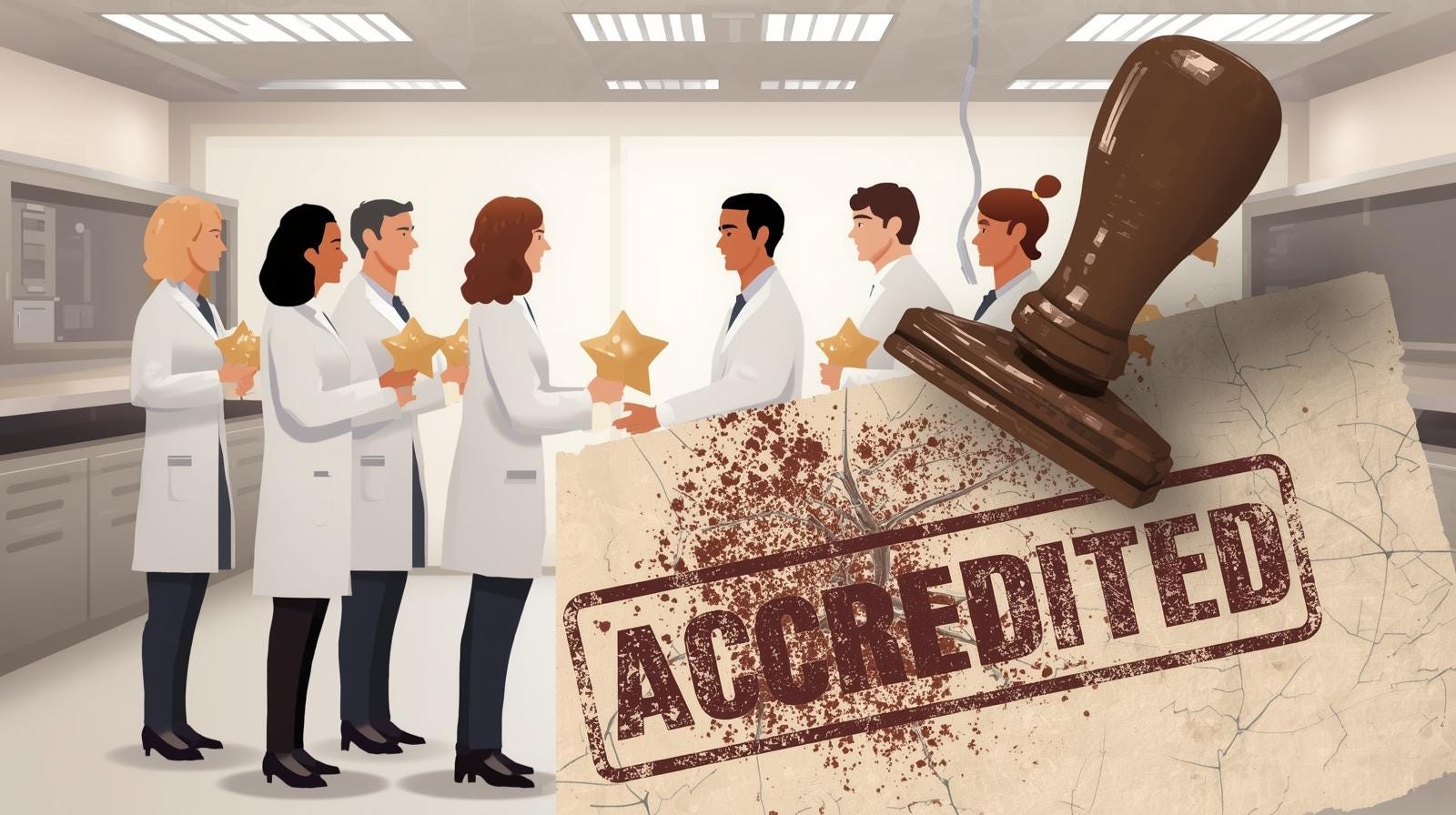
The central argument: accreditation does not mean what courts think it means.
One organization. 94% of the market.
ANAB accredits roughly 94 percent of all forensic providers in the United States. Combined with A2LA, two private organizations control more than 99 percent of forensic accreditation.
Neither carries the transparency obligations or enforcement mandates of an actual regulatory agency. Yet courts routinely hear that accreditation means a lab operates under the most rigorous standards.
A closed loop
In most non-forensic ISO/IEC 17025 programs, assessors come from diverse technical backgrounds across multiple industries. That outside perspective matters.
Forensic accreditation works differently. ANAB’s program relies on volunteers drawn directly from other crime labs.
They attend the same conferences, belong to the same professional organizations, and operate within the same law enforcement structures as the labs they assess. When your assessor works at a lab, you may assess the next cycle; the incentive to flag problems is structurally suppressed.
Three labs. Three failures. All accredited.
Randox manipulated calibration data for years before a defense expert caught it reviewing raw data in a single case.
Maryland used single-point calibration for blood alcohol testing for a decade, passing two accreditation cycles before anyone cited it.
The UIC lab couldn’t adequately separate delta-8-THC from delta-9-THC internally in 2021 and kept the method in use until 2024.
Accreditation confirmed procedures were being followed in every case. It missed the science.
The bottom line
Accreditation should be the beginning of scrutiny. Not the end of it.
The paper is open access in Forensic Science International: Synergy: https://www.sciencedirect.com/science/article/pii/S2589871X26000148