

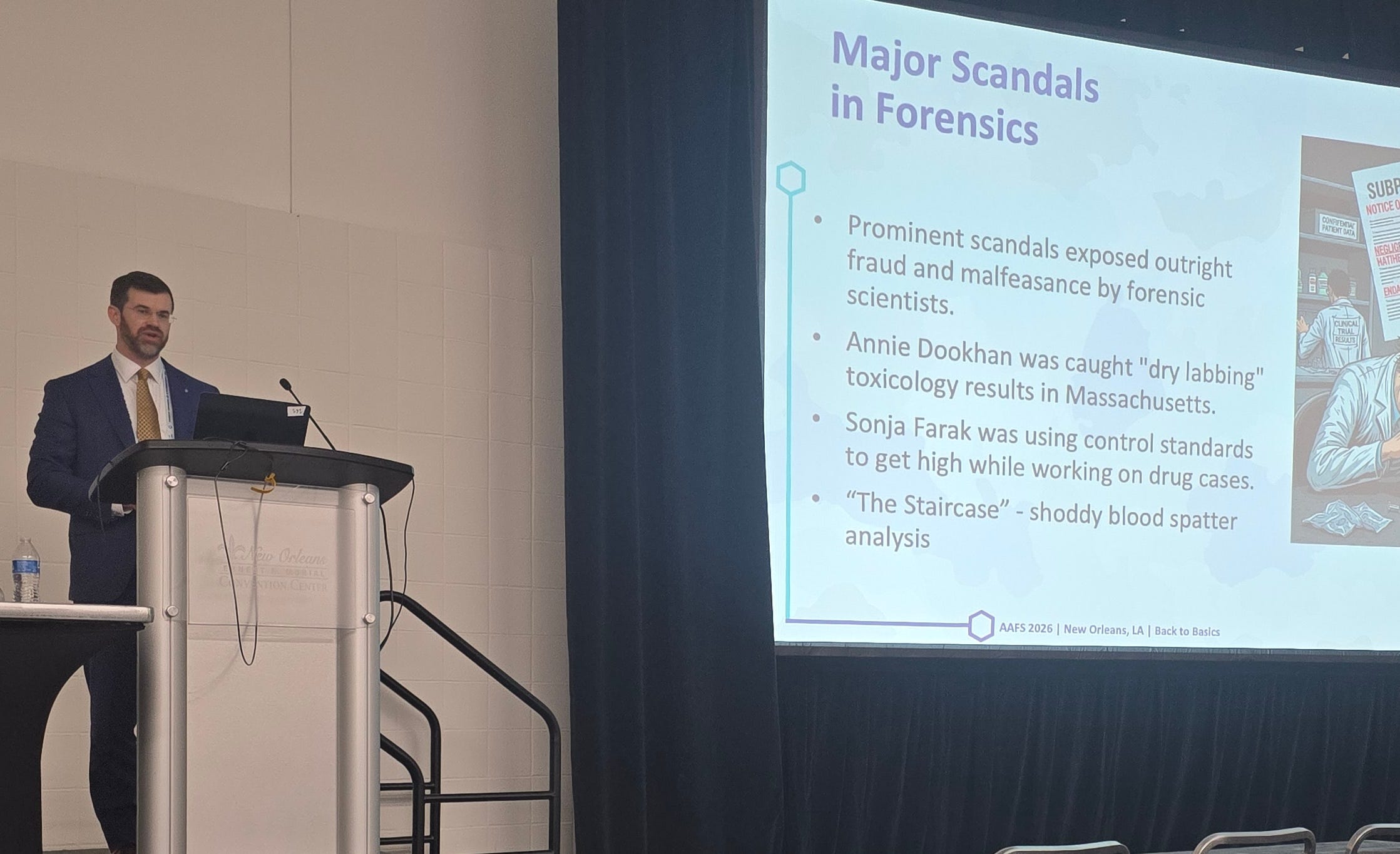
Last week, I presented at the American Academy of Forensic Sciences in New Orleans, LA.
I presented on a topic that sits at the foundation of forensic science: how laboratory errors happen and why full discovery is essential to preventing them.
I examined and documented toxicology failures and categorized recurring error patterns, including calibration failures, traceability breakdowns, discovery violations, source code defects, contamination, reporting errors, and even fraud.
Several themes stood out.
First, many errors persisted for years or decades before detection. A 14-year breath alcohol miscalibration in Washington, DC is one example. Other method and software defects survived multiple accreditation cycles.
Second, major failures were often uncovered by outside parties, new employees, or whistleblowers rather than internal quality systems. Institutional resistance to disclosure frequently delays correction.
Third, technical competence alone is not enough. Culture, transparency, and oversight are just as critical as analytical skill.
I outlined practical reforms, including mandatory online discovery portals, preservation of digital data and metadata, independent oversight, whistleblower protections, and regular third-party audits.
The takeaway is simple: If these vulnerabilities existed elsewhere, they likely exist in other jurisdictions today.
Forensic science earns public trust through accountability and transparency.
You can read the full analysis in my published article here: https://www.sciencedirect.com/science/article/pii/S2589871X25000580