

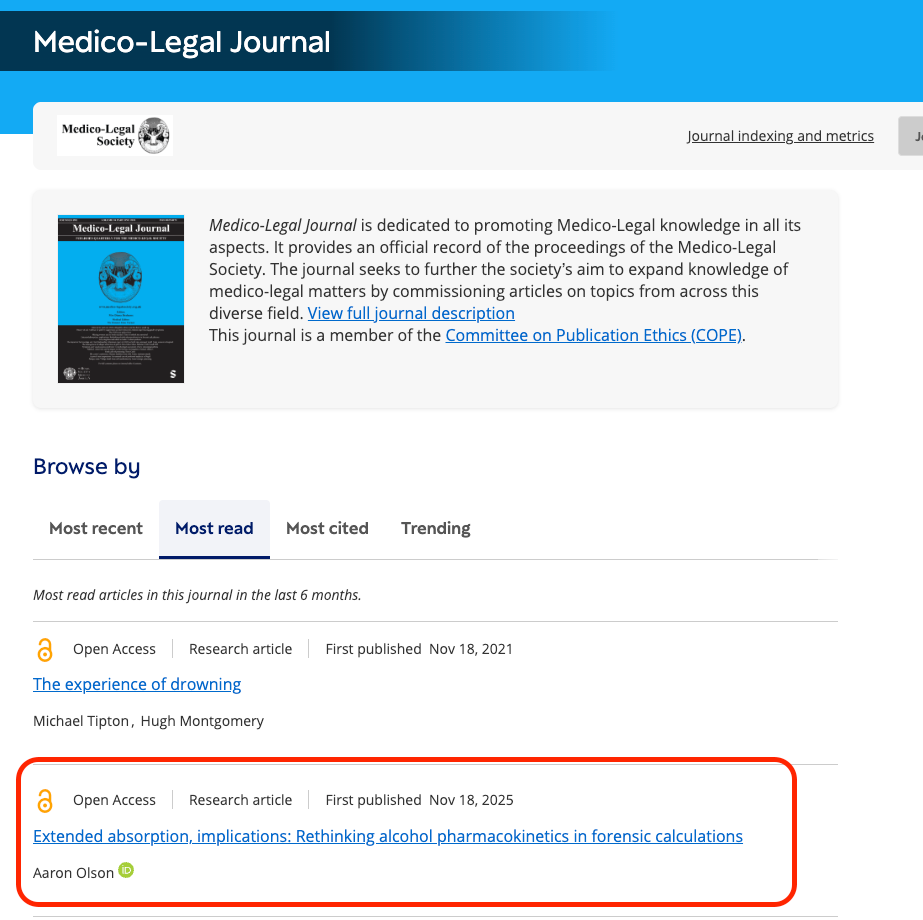
I was happy to see that my article, “Extended absorption, implications: Rethinking alcohol pharmacokinetics in forensic calculations,” is currently listed as the second most read article on the Medico-Legal Journal website.
It is both humbling and encouraging.
The article deals with a topic that comes up often in impaired driving cases but does not always receive the attention it deserves: how long alcohol absorption can actually take.
In forensic alcohol cases, toxicologists are often asked to perform retrograde extrapolation calculations.
These calculations attempt to estimate what a person’s alcohol concentration may have been at an earlier point in time, such as the time of driving.
But for that type of calculation to be reliable, one key assumption has to be true: the person must be in the post-absorptive phase of alcohol distribution.
A common assumption in forensic practice is that alcohol absorption is complete within two hours of the last drink.
My article questions how broadly that assumption should be applied.
The pharmacokinetic literature shows that alcohol absorption can vary substantially from person to person and from situation to situation. Food, medications, trauma, medical conditions, gastric emptying, and other case-specific factors can all affect absorption timelines.
In some cases, absorption may extend well beyond the commonly assumed two-hour window.
That matters.
If a person is still absorbing alcohol, retrograde extrapolation can overestimate the alcohol concentration at an earlier time.
In a legal context, that is not a minor technical issue. It can affect how evidence is interpreted, how expert opinions are formed, and how cases are argued in court.
The fact that this article is being widely read suggests real interest in this topic among lawyers, scientists, experts, and others working in the medico-legal field.
Alcohol pharmacokinetics is often presented in simplified terms, but real-world cases are messy.
People eat meals, take medications, have medical conditions, suffer trauma, drink different types of beverages, and metabolize and absorb alcohol differently. Forensic opinions should reflect that complexity rather than hide it behind overly rigid assumptions.
I am grateful to the Medico-Legal Journal for publishing the article, and I appreciate everyone who has taken the time to read it, discuss it, or share it.
The broader takeaway is simple: population averages are useful, but they should not be treated as guarantees in individual forensic cases.
When alcohol calculations are used in court, the assumptions behind those calculations deserve careful scrutiny.