

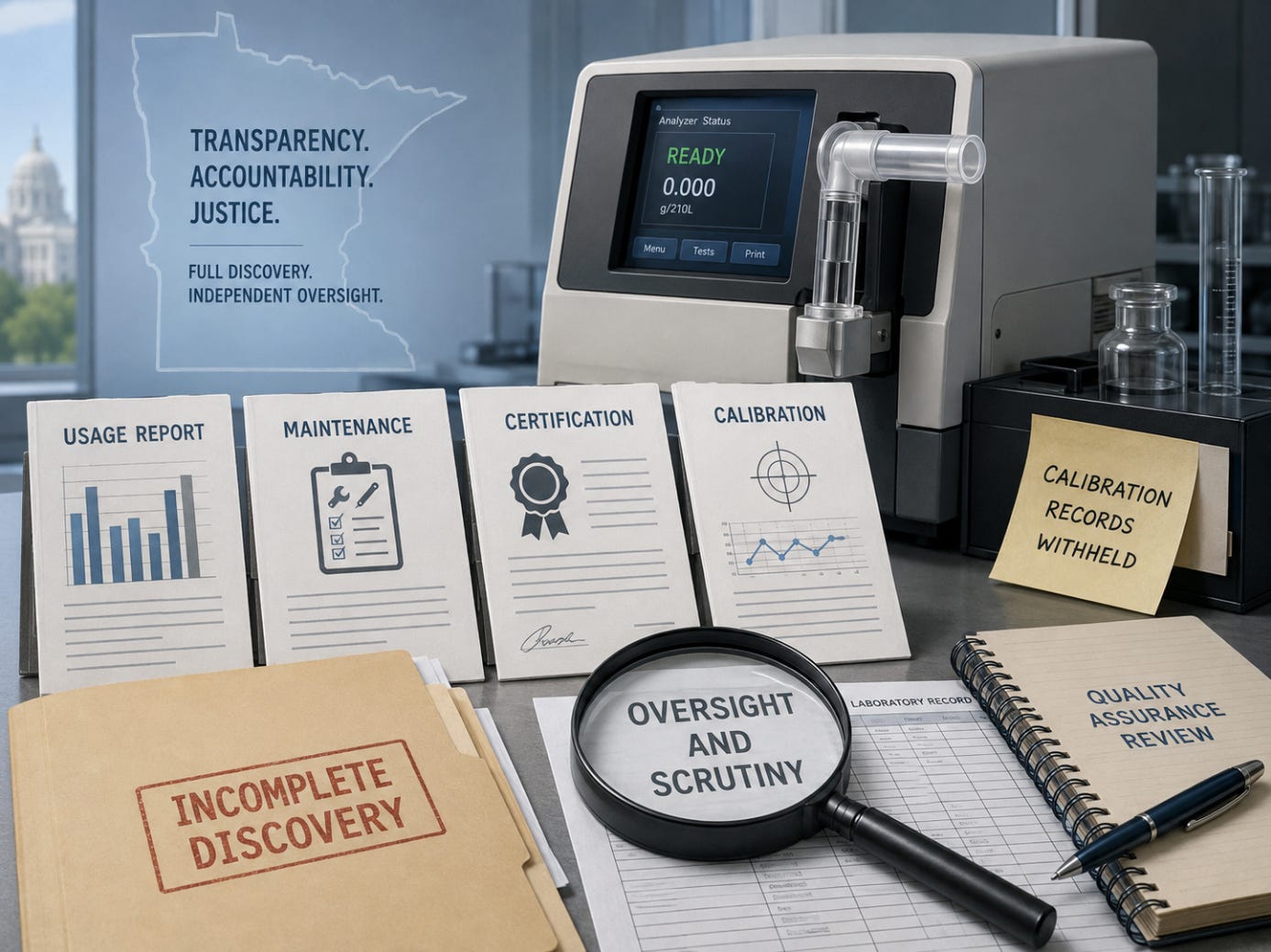
The BCA Is Not Following Its Own Discovery Policy
The Minnesota Bureau of Criminal Apprehension (BCA) Breath Alcohol Calibration Laboratory is not following its own stated discovery practices, making it harder to evaluate the reliability of breath-testing instruments used in DWI cases.
Under BCA policy FSS-6302, public information from the Breath Alcohol Calibration Laboratory includes DMT usage reports, maintenance reports, and certificates of calibration. The policy states that a standard usage report consists of:
“…three months prior through one month after the DMT test date. If a longer duration is requested, the Usage Report will consist of a maximum of 10 years prior to the DMT test date to the current date.”
That is not what the BCA is currently providing.
The Usage Reports Are Being Limited
The BCA has recently been providing usage reports covering only one month before the subject test.
That is a clear departure from its written policy.
A one-month usage report may show only a handful of tests. This gives an unnecessarily narrow view of how the instrument was performing in the field.
A broader usage history can reveal patterns, repeated errors, failed tests, unusual results, or other information relevant to evaluating reliability.
Narrowing that window to just one month limits the ability to conduct a meaningful review.
Certification Records Are Also Important
Limited certification records are another concern.
FSS-6302 states that certification records will be provided if requested and available.
However, BCA practice is to provide certification records only for the most recent certification.
Additional certification records require follow-up requests and more approval.
These Records Should Be Easy to Obtain
Usage, maintenance, calibration, and certification records are directly relevant to determining whether a breath-testing instrument was operating reliably.
They should not require repeated requests, additional correspondence, or unnecessary delays.
In many jurisdictions, similar records are made readily available through public online discovery portals. Minnesota should be doing the same.
Why Independent Oversight Is Needed
This problem goes beyond one discovery request or one breath-testing instrument.
In the article Daniel Koewler and I recently published in MinnPost, we documented a recurring pattern in Minnesota forensic science: problems are typically discovered only through independent scrutiny.
Minnesota needs an independent forensic science oversight body with the authority to review laboratory practices and require meaningful transparency.
The BCA’s failure to follow its own written discovery policy is another example of why that oversight is necessary.
Transparency Should Not Be Optional
When a forensic laboratory has a written policy requiring broad discovery, it should follow that policy.
Scientific evidence used in criminal cases must be open to meaningful review. Limiting access to instrument records undermines confidence in the process.
Transparency should be the default.