

What Assumptions Are Built Into Breath Alcohol Calibration?
Breath alcohol calibration may seem straightforward: prepare a simulator solution, heat it to 34°C, and use the vapor above the solution as a reference standard.
But there is an important assumption built into that process.
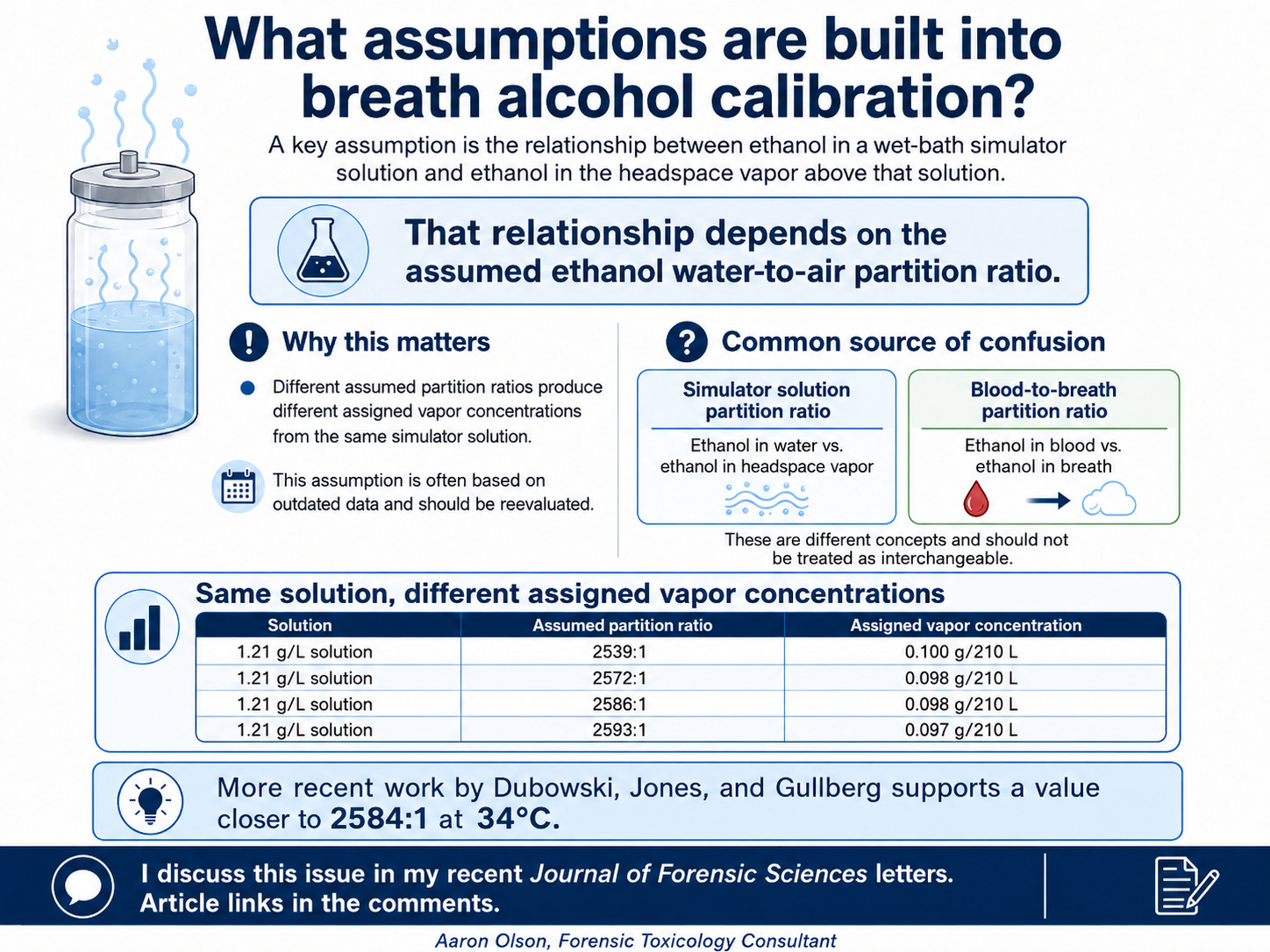
The vapor concentration produced by a wet-bath simulator solution depends on the assumed ethanol water-to-air partition ratio. That ratio describes the relationship between ethanol in the liquid solution and ethanol in the headspace vapor above it.
This is not the same thing as the blood-to-breath partition ratio.
One involves a calibration solution. The other involves alcohol in the human body. They are separate concepts and should not be treated as interchangeable.
This issue came up in my recent letter to the editor in the Journal of Forensic Sciences regarding ethanol depletion in non-recirculating breath alcohol simulators.
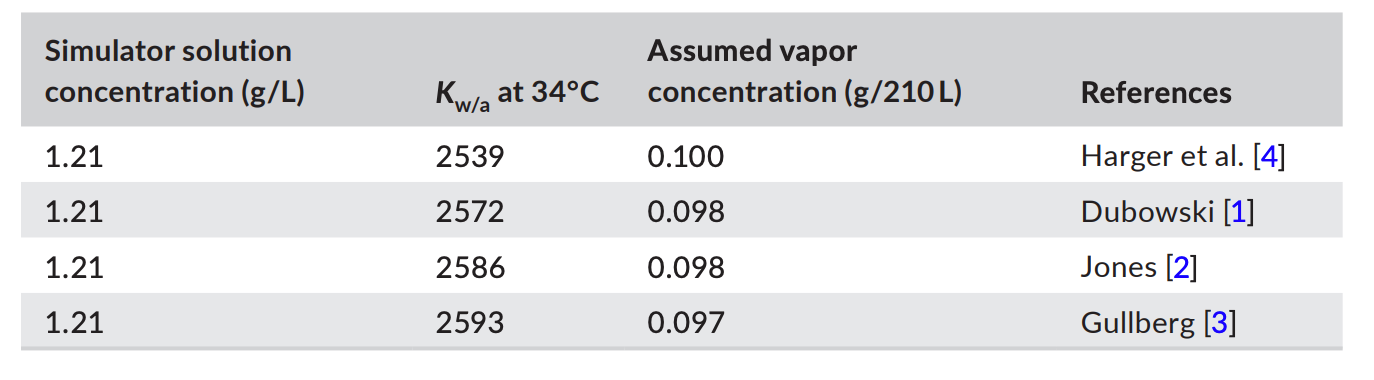
One concern I raised was that the authors used Harger’s older value of 2539:1 without adequately addressing uncertainty around that assumption.
More recent values reported by Dubowski, Jones, and Gullberg average to approximately 2584:1.
That difference changes the assigned vapor concentration produced by the same simulator solution.
You can see the differences in the table below:
This assumed ethanol water-air partition ratio matters because simulator solutions are used as reference materials.
If the assigned vapor concentration is based on an outdated or poorly justified partition ratio, that assumption can affect calibration, verification, depletion studies, and uncertainty estimates.
The larger point is simple: breath alcohol calibration depends on assumptions, and those assumptions should be clearly stated and periodically reevaluated.
When assumptions change or older assumptions are shown to be less reliable, the field should take notice.
I recently discussed these issues in two Journal of Forensic Sciences letters regarding ethanol depletion dynamics in non-recirculating breath alcohol simulators available here:
Olson A. Response to authors’ reply. J Forensic Sci. Epub ahead of print 7 May 2026. DOI: 10.1111/1556-4029.70352.
Olson A. Commentary on: Fogarty‐Harnish O, Yeakel JK, Pauley TL, Svirbely ET, Barry SP. Ethanol depletion dynamics in non‐recirculating system breath alcohol simulators. J Forensic Sci. 2025;71 (2):1032–9. 10.1111/1556‐4029.70222. J Forensic Sci. Epub ahead of print 7 May 2026. DOI: 10.1111/1556-4029.70354.