

What happens when scientists observe ethical problems and don’t feel safe reporting them?
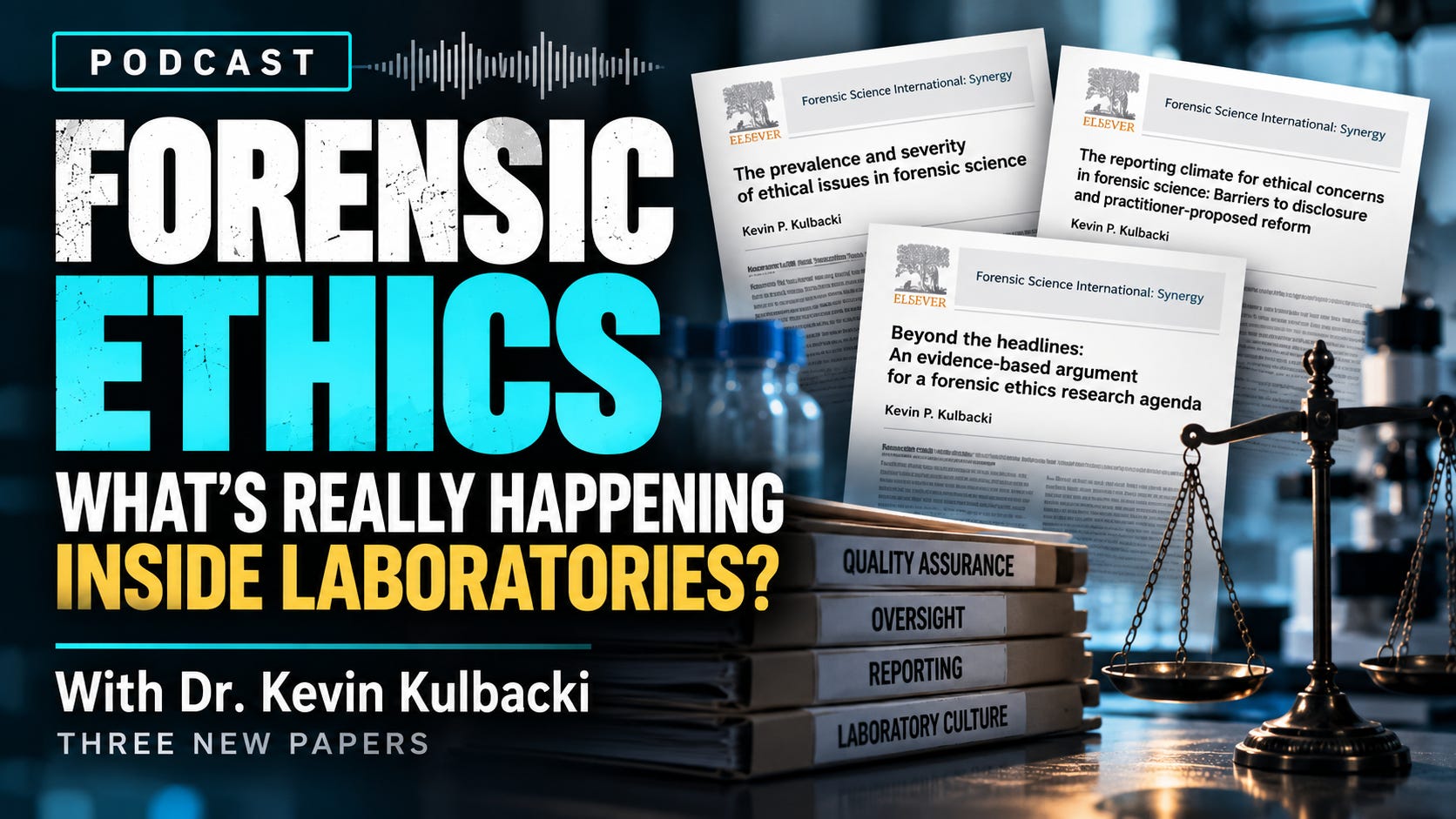
I spoke with Dr. Kevin Kulbacki, a forensic document examiner and founder of KDX Forensic Consulting, about his three recent publications in Forensic Science International: Synergy, which examines ethical violations, laboratory culture, and barriers to reporting misconduct.
Kulbacki surveyed 1,338 forensic science professionals internationally to better understand how frequently ethical issues occur, how serious they are, and why they go unreported.
His findings raise some uncomfortable questions about the effectiveness of our existing laboratory oversight systems.
Among respondents who answered:
36.7% reported observing or becoming aware of ethical violations in their laboratories over the previous decade.
58.7% of North American respondents reported observing ethical violations, compared with 19.8% of European respondents.
48% reported feeling pressured to rush casework.
20.7% of North American respondents reported being pressured, or consciously deciding, not to document something because of concerns about discovery.
Even more concerning, among respondents who reported observing violations and characterized their severity, 16.8% identified conduct they considered potentially criminal.
Why Scientists Are Afraid to Speak Up
One of the most interesting findings was what Kulbacki describes as the infrastructure–trust paradox.
North American laboratories reported having more mechanisms to detect and report ethical concerns than European laboratories. Yet North American practitioners expressed substantially less confidence in those systems.
Among North American respondents who hesitated to report violations, nearly 70% cited fear of retaliation, while 77% feared nothing would change.
As Kulbacki explains, having a reporting mechanism doesn’t necessarily mean scientists trust it enough to use it.
The Importance of Documentation and Discovery
Forensic scientists are frequently taught that if something isn’t documented, it didn’t happen. Yet important discussions may occur through emails, phone calls, instant messages, or conversations that never make their way into the laboratory’s case records.
Kulbacki says that laboratories should establish stronger documentation policies and provide greater transparency about the additional records that may exist beyond the final laboratory report.
His advice to scientists who witness questionable practices is straightforward:
“Document everything.”
Kulbacki believes forensic science needs a more systematic approach to studying organizational ethics, including independent research into laboratory culture, meaningful external oversight, and better mechanisms for protecting practitioners who report concerns.
We also discussed whether separating laboratories from law enforcement would improve scientific independence. Although Kulbacki believes greater independence may help, he cautions that structural independence alone cannot eliminate ethical problems.
To improve the reliability of forensic science, we must understand why those problems occur, why they go unreported, and how to prevent them.
Clips
Learn More
Papers discussed in this episode:
1. The prevalence and severity of ethical issues in forensic science
Kevin P. Kulbacki (2026), Forensic Science International: Synergy
https://doi.org/10.1016/j.fsisyn.2026.100743
2. Beyond the headlines: An evidence-based argument for a forensic ethics research agenda
Kevin P. Kulbacki (2026), Forensic Science International: Synergy
https://doi.org/10.1016/j.fsisyn.2026.100728
3. The reporting climate for ethical concerns in forensic science: Barriers to disclosure and practitioner-proposed reform
Kevin P. Kulbacki (2026), Forensic Science International: Synergy
https://doi.org/10.1016/j.fsisyn.2026.100736
Connect with Dr. Kevin Kulbacki:
Website: KDX Forensic Consulting
LinkedIn: Kevin P. Kulbacki
Automated Transcript (not checked for errors)
Aaron Olson (00:00)
Kevin, thanks so much for coming on the pod.
Kevin Kulbacki (00:02)
Thank you for having me.
Aaron Olson (00:04)
So Kevin, you recently undertook this series of or you published had three papers published in Forensic Science International Synergy investigating forensic for ethical issues in forensic science. Tell me about a little bit about what motivated you to undertake this research.
Kevin Kulbacki (00:21)
Well, I I think as a lot of forensic scientists will know, there are things that we all see that happen within our laboratories that may not sit right with you. And just as with everybody else, I noticed things over the course of my career that really did not add up and did not seem to be appropriate in a forensic environment. And so ultimately it led to me going down this path of asking other experts about their own experiences.
Kevin Kulbacki (00:48)
And what I found over and over again is everybody had a story. And some of these stories were things that, if they were ever public, would would be close the lab level scandals. And so the thing I realized is nobody has a way of actually talking about these things. If you go out and just say what happened, the reality is you are probably going to face some level of blowback, whether you’re actually able to disclose that information. a lot of our cases are things that are
Kevin Kulbacki (01:16)
secret their pre-grand jury or things of that nature. We can’t just go out and talk about what we see. So I wanted to figure out a way to test that and figure out how prevalent and severe are these issues that are actually going on and what are the reasons that are actually out there that are preventing people from coming forward and and getting these issues out.
Aaron Olson (01:38)
Yeah, so y you surveyed more than three hundred forensic science practitioners internationally. why d how did you go about designing that methodology?
Kevin Kulbacki (01:49)
So the the total number actually was 1338 respondents across the world. The intent on that was not really necessarily about getting regional distributions. Sooner I just was trying to see how big of a sample size could I actually get. You know, when we started first talking about this, my advisor and I, the thing that I that we kind of came to is this is gonna be difficult. There’s gonna be a a big challenge of getting people to trust you with this information.
Kevin Kulbacki (02:18)
And so we really were actually talking very small scale, Hey, if we get a hundred people to respond to this, great. luckily, I I happened to reach out to a whole bunch of different people who helped me spread this. various different organizations, your the American Academy, NC in Europe, AFQM, some of the Australian groups also shared it. It was very widespread, and and thankfully, practitioners did seem to.
Kevin Kulbacki (02:46)
to get the message and did seem to trust the level of protections that were put into it. And because of that, it allowed us to to just get this massive sample size. I I was not anticipating that. that was never the intent, but thankfully we were able to get there.
Aaron Olson (03:02)
Yeah, yeah. That’s pretty im impressive that you were getting able to get so many people to respond. One of the interesting things I found from reading your papers was that there were thirty six percent of respondents who answered that the the question that they observed ethical violations in their laboratory. Were you surprised that the number was so high?
Kevin Kulbacki (03:24)
No, so that that was one of the harder parts of this that had to kind of be really figured out earlier is how do you define an ethical issue? There’s there’s not really a good skill for that. the best that I could find was some of the work of Angela Ranadive and as as well as Swinson.
Kevin Kulbacki (03:43)
In their book, they had a five-point scale defining issues, and it ranged from incidental errors and omissions all the way up through things that they would describe as criminal. Now, a lot of our types of issues are things that probably have not gone through some form of adjudication process. And so forensic scientists being very particular, of course, I’m not gonna say criminal when you know they’re gonna say, well, it might have been, but it wasn’t ever charged, so we’re not gonna say that. So aside from adapting that phrase to be potentially criminal.
Kevin Kulbacki (04:13)
I I’m not surprised at the overall percentages. I think the overall percentages make sense in in the greater scheme of things. Because we as forensic scientists know that incidental errors and omissions happen. if we if we chose to ignore that point, then it it gets a little bit more dicey. How how often do you expect these higher level things to be occurring? But overall, error is normal. and that should be expected. that’s why we have quality assurance systems in the first place.
Kevin Kulbacki (04:44)
So I I would say overall I was not surprised. The numbers when we got to the higher levels, though, that gets a little bit more dicey, and I am certainly surprised by some of those numbers in terms of how many people are reporting more serious issues.
Aaron Olson (04:59)
Tell me more about those numbers that you’re thinking about.
Kevin Kulbacki (05:03)
For example, when we start going into the actual severity levels, like I said, there there are five levels: level one being your incidental errors and omissions.
Kevin Kulbacki (05:12)
Two being general malpractice, three being general misconduct, fourth being gross misconduct or negligence, and fifth being potentially criminal, as you would expect, as we get into the higher levels, that number does drop, the percentages do start to drop. But seeing potentially criminal and seeing a number pop up, you know, the overall with 16.8% of respondents, and granted, I should clarify.
Kevin Kulbacki (05:40)
These this question was only asked to those people who had seen something. So it is allowing us to get a little bit more insights into what that population is saying they saw. But I think what was fascinating to me is the overall. overall, we had 58.7% of North American respondents saying they’ve seen something in their laboratory in the last decade. potentially criminal on top of that, North America was 19.1%. if you just apply a basic product rule,
Kevin Kulbacki (06:10)
means about 11% actually in North America have seen something that would be a potentially criminal action occurring within their laboratory. And I think that’s why I think this data is so interesting is because we have never had numbers to these these criteria. We’ve never had numbers to to define ethics and forensics. And so this is the first time people are having to actually kind of confront that.
Kevin Kulbacki (06:36)
And now I’ve had the the benefit of the doubt of I’ve been sitting on this data while I’ve been working on this. And so I’ve had the ability to figure out how to contextualize that. And what I’ve come up with is, there are two numbers that you need to think about for every single question in this research. one, what is the ideal response rate for this question? ideally, 0% of people should be saying that they’ve seen something potentially criminal in their laboratory, you know.
Kevin Kulbacki (07:04)
Well then you have to think about the second part, which is what is an acceptable level? We know it’s not zero percent. We do hear about these scandals that involve conduct that clearly is potentially criminal. So you might say, hey, that might occur in one percent of laboratories. So when you start then seeing, nineteen point one percent of these people who had said they’d seen something in the US or North America, I should say, saying they’ve seen something potentially criminal, and that
Kevin Kulbacki (07:32)
Product role applying would make it about 11% of laboratories in the North American region. That’s really staggering. You know, that’s not 1%. That is a much broader problem than we possibly were ever thinking about. And so that’s why I find this data kind of so fascinating at a certain point, is because it’s it’s putting numbers on things, and those numbers probably are not a flattering endorsement of what you thought the situation was.
Aaron Olson (07:57)
Yeah, we often only find out about these errors when a scandal takes place, but obviously there’s many errors that happen that never make the headlines. And I think that’s what you were what you were getting at with this survey is trying to find out what’s the underlying rates and compared to what’s actually reported. What it what yeah.
Kevin Kulbacki (08:16)
I exactly. And
Kevin Kulbacki (08:17)
and if I may, so what I would suggest is, some of this we expect we’re not gonna see. incidental errors and omissions, general malpractice, even general misconduct, those are things that, can be dealt with by a quality assurance system. But when you start getting up to things that are potentially criminal, that’s getting outside of the bounds of a laboratory. That’s where, you’re impacting somebody’s life or liberty, and therefore it is likely a a something that needs to be dealt with.
Kevin Kulbacki (08:45)
By somebody outside the laboratory. This isn’t just a slap on the wrist or a corrective action. This means that we need to have somebody look at this and see did you actually do something that violated somebody else’s rights? So while we hear about those scandals, they are very much just the tip of the iceberg. And what this is suggesting is that it does go much deeper than what we are hearing about in these scandals. It’s not things that just we’re not hearing because they’re dealt with internally.
Kevin Kulbacki (09:13)
These are the level of scandals that probably shouldn’t be dealt with.
Aaron Olson (09:18)
Yeah. Do you have any sense for what types of behaviors would fall into those categories that would amount to a criminal?
Kevin Kulbacki (09:24)
So I wish that I could give you a a response to that, but that was intentionally something that we avoided for this research. And the reason for that is if I was to gather any level of information on something on that, I would then have an ethical responsibility to report that conduct as well. And one of the most significant concerns that I had in doing this research was making sure that people could actually be anonymous. You know, I did not want to put people in a situation where
Kevin Kulbacki (09:54)
This is going to come back to bite them for them responding to a survey. And I think that’s the hard part about forensics, is our situations that we get involved in are so nuanced that there may only be a handful of people who know about that situation. So even if I were to ask you to anonymously describe a situation, somebody’s going to connect the dots on the back end of that if that information was ever public. So we very much limited by design any freeform input.
Kevin Kulbacki (10:23)
within the survey so that things were more generic. They were advised not to give anything that was specific to their laboratory or specific to individuals, just so that we could try and protect people on the back end. I wish that I had more information there, but like I said, that was that was intentional that I don’t have that information.
Aaron Olson (10:42)
Yeah. Were you surprised that more North American respondents reported ethical violations than European respondents?
Kevin Kulbacki (10:51)
So I I don’t have a good answer on that question. I don’t know. and that partially goes down to cultural differences. Here in North America, we do, and this is something that was described by the respondents, tend to have more of a captive profession where we are, for a lot of laboratories, embedded within law enforcement. In Europe, you don’t see that. You see a lot more educational institutions that have forensic laboratories as part of the institution.
Kevin Kulbacki (11:18)
And so I can’t tell you whether that is coming out of a cultural difference or not. All I could say is kind of we very clearly seemingly have more infrastructure to seemingly prevent ethical issues, but we also have less trust in it in North America than our European counterparts do.
Aaron Olson (11:38)
Yeah, for example, North American respondents nearly seventy percent cited fear of retaliation and seventy seven cited that fear that nothing was would change. do you think that also that’s also due to the organizational culture of the laboratories, I would think as well.
Kevin Kulbacki (11:57)
Absolutely. I I think most of this comes down to culture. I think at a certain point, it comes down to, again, we’re we’re talking very small-scale scenarios. In an average case, the only people who really know the intricacies of the case are the actual examiners as well as their leadership and people who are involved in the investigation. Sure, your colleagues might know what you’re working on to some extent, but most of the ethical issues are.
Kevin Kulbacki (12:24)
gonna be siloed because the information is also siloed. And because of that, I think you’re gonna have these situations where exactly as as described, people may feel they have nowhere to report an issue because the people involved in the issue are also involved in the situation as well. And that that comes again to that captive profession. We don’t really have outside channels that we can go and talk about these issues with without getting ourselves in other forms of legal trouble. So because of that,
Kevin Kulbacki (12:54)
Who do you trust when something goes on? you might have somebody in your laboratory you could talk about it with, but that’s not the same as actually somebody who’s in a position to do something about it.
Aaron Olson (13:04)
Right. Have you thought about solutions to this problem?
Kevin Kulbacki (13:08)
I think there are are are certainly a few, but it is such a nuanced problem that I think we’re going to have to figure out on a broader scale how these problems actually interact with one another. one that I did see over and over again coming from the respondents was that leadership should be chosen not based on seniority, but based on actual leadership competence. just because you are technically good at what you do does not mean that you’re gonna be a good administrator for a laboratory.
Kevin Kulbacki (13:38)
At the same point, I think a lot of this also comes down to whether or not your policies and procedures are designed in such a way that they actually protect your examiners. And the example I’ll go to for that is with respect to the question on discovery. have you ever been pressured to or consciously decided not to document something in writing due to potential discovery? That number was which was much higher. And if you give me one moment, I’ll pull it up.
Kevin Kulbacki (14:06)
But the mu number was much higher than you would have ever hoped for a question like that. And so I think a lot of it comes down to in laboratories we’re told, from the beginning of our careers, if it’s not documented, it didn’t happen. But how many conversations happen in an instant message? How many conversations happen in the hallway or on a phone call that then don’t wind up into your limps where it’s going to be discoverable after the fact? I think that’s that’s kind of these these.
Kevin Kulbacki (14:35)
We’ve had these great ideas of how to do things in theory by telling people if it’s not documented, it didn’t happen. But that’s not the same as an affirmative policy saying you need to document everything. And if an examiner says that it should be documented, it should be documented. there’s there’s a level of entrusting your examiners to be able to document something. And even going one step further, one thing that we as forensic scientists
Kevin Kulbacki (15:04)
tend to be not very good at just from a policy perspective is we issue reports that just say, here’s your answer. We don’t really tell the people who are going to be viewing those reports what other information exists within our laboratory. So, the fact that, hey, this report might be supported by notes, it might be supported by a communications log, there are laboratory SOPs, there are quality assurance measures that go into place.
Kevin Kulbacki (15:33)
We don’t put a list of here are the other things you can request on the back end of our reports. And because of that, some defense attorney on the other side of a case or a prosecutor on the other side of a case is gonna assume, hey, this is what they turned over to me. This has to be everything, and they’re gonna make their decisions off of it. If they don’t know what did what happened or didn’t happen behind the scenes, how can the court system make a an informed decision either?
Aaron Olson (15:59)
Yeah, yeah. In your third paper, or I guess I would call it the editorial that you published along with these two papers documenting your survey, you talk about how there needs to be a separate scientific discipline for forensic ethics. What did you envision for that?
Kevin Kulbacki (16:16)
I wouldn’t say a separate discipline. the the methodology for doing this type of research exists within other domains. We just don’t apply it here the same way. So we think about cognitive bias, for example, and we we over the last, you know, I’m gonna say about five to ten years, people have started to accept that and started to realize that okay, there are ways to do this and do it differently. We think about quality assurance and we think about how to
Kevin Kulbacki (16:43)
To study quality assurance on how to make things better. What I mean is ultimately at the end of the day, I think we need a forensic ethics research domain. And what I mean by that is it is studying something in a different context, utilizing methods that have been applied in other industries. This is something that I don’t think we as a organization or as a field really are good at studying ourselves. You know, and the example I’ll give is I’ve been asked.
Kevin Kulbacki (17:11)
Whether or not this survey could be replicated within a given laboratory. And my answer was basically no, because if you try to replicate this within a laboratory, the odds are that those same fears that people are reporting are going to be the things that are going to influence how they respond to those questions. So we really need to think about how to do this on a broader scale. And that requires very broad buy-in from the industry.
Kevin Kulbacki (17:38)
accrediting laboratories, for example. You may not be able to do this in your own individual laboratory. But if an accrediting body said, we are going to participate in this research and we want this distributed amongst everybody within everybody’s labs, okay, you start getting towards a better way of of getting answers on a broad scale. You need that kind of institutional buy-in. But to go one step further, it has to be from outside. It cannot be from
Kevin Kulbacki (18:05)
People who are seen as being part of that system. It can’t be your laboratory, it can’t be your parent agency. And I would argue it probably can’t even be the accrediting body itself who would do this research because they have a vested interest in it. It needs to be working with external bodies using validated instruments to be able to actually get this data in such a way that people feel they can respond without getting themselves into potential trouble after the.
Aaron Olson (18:33)
Yeah, yeah. You you mentioned there the close relationship that a lot of forensic laboratories have with law enforcement and sometimes prosecutors. do you think, you know, the two thousand nine NAS report talked about having more independence amongst laboratories and s separating them from prosecution and law enforcement. Do you think there’s any movement towards actually achieving that?
Kevin Kulbacki (18:56)
there’s been little movement here and there, but it isn’t necessarily while that was one of the things that that respondents very frequently did bring up is that kind of captive nature being with embedded within law enforcement as being a potential issue. It doesn’t necessitate that it is also going to then fix the issues, you know, and they the great case study example for that is DC. You know, DC at the time that their issues were occurring was an independent organization.
Kevin Kulbacki (19:25)
It was an accredited independent organization that was set up specifically following the 2009 NAS report guidelines. And the issues can still happen. So the reality is I don’t think that solves the problem. I think it is something that, you know, seemingly examiners think would assist by adding a layer of insulation between them and their investigators. But ultimately at the end of the day, it’s not going to be the end-all be-all fix for these issues.
Aaron Olson (19:56)
Yeah. I if you were thinking about this and you were put in charge of a forensic laboratory, what sorts of imp policies would you have in place to try to fix some of these issues?
Kevin Kulbacki (20:07)
I think the the hard hardest part, and the thing that I think is is the holy grail, so to speak, is there needs to be some level of an o external oversight over forensic laboratories. And what I mean by that is not necessarily a commission. You know, commissions are raised frequently as being an idea that might work. And to be fair, they very well may do the trick. But I think the bigger issue that I see is there needs to be someone who is outside the system who
Kevin Kulbacki (20:35)
understands the nuances of forensics enough that they can be a sounding body for when something goes on. And I think that’s where I think we we have a current disconnect because again, so much of the work that we do is secret by the very nature of of what we’re doing and who we’re doing it for, that you can’t just go and tell somebody outside of your laboratory what’s going on. Because for all you know, they may be involved in the investigation, you know, in some other capacity.
Kevin Kulbacki (21:03)
They may be on the other side of a case. There needs to be somebody that an examiner, when something happens, can go to and say, Hey, here is what happened in my laboratory. here is whatever documentation we have. So that there can be a body who understands the nuances well enough to be able to say, okay, this is or this is not appropriate, and then potentially step in to give guidance to a laboratory on how to fix that issue. And and again, the hard part is you can’t ever
Kevin Kulbacki (21:34)
really add in whistleblower protections to our industry again because these issues are so nuanced and there’s so few people involved that everybody involved is gonna know who is involved in the situation. You know, it’s not like you can really have an anonymous reporting channel. Frankly, that’s not gonna exist for us in most cases because the the information is so siloed. But again, if we have some level of external body that people can trust.
Kevin Kulbacki (22:02)
to be able to report things to that would go a long way in at least giving examiners an outlet to say, hey, something’s going on here. Can somebody look at this situation for us?
Aaron Olson (22:16)
So for forensic professionals listening to this, do you have any advice? what advice would you give them if they witness questionable practices in their lab?
Kevin Kulbacki (22:26)
Document everything. That is you know, that is the thing that has drilled into us from day one in this industry. Is if it did if it isn’t documented, it didn’t happen. I don’t care if your laboratory management is telling you not to document something. Document everything because that is your only protection at the end of the day. You know, if we look at the reviews that we’ve seen come out of some of these other scandals, we constantly see that people knew what was going on.
Kevin Kulbacki (22:53)
People knew who the people were who had issues. People knew when there were quality things that were going on in the laboratory. And nothing happened. The more you document that situation, the more there is a body which people will not be able to ignore later on when something goes wrong. You know, it it’s we see this so often where people kind of blame the individual who was involved in the situation. And sure they absolutely play a huge part of that.
Kevin Kulbacki (23:22)
But so much of it is also the system that enables it. And so if you are documenting things in a way that they are discoverable after the fact, it makes it so that there is going to be blame cast accordingly, if there are other people who are choosing not to act on that information. So even though it’s uncomfortable, even though you may face some level of retaliation for documenting something that you know is perhaps an uncomfortable talk dot an uncomfortable topic for your laboratory.
Kevin Kulbacki (23:51)
it’s still valuable to have that level of information to protect yourself.
Aaron Olson (23:55)
Yeah. I kinda glossed over a bit about your yourself and your background. Tell me a little bit more about yourself and what kind of forensic examinations you do, how you got into this.
Kevin Kulbacki (24:05)
So I
Kevin Kulbacki (24:07)
absolutely so I am a forensic document examiner. I’ve been in this field for about 15 years at this point. started in the private sector. I’ve worked for state law enforcement and federal law enforcement. Now back in the private sector. you know, the benefit of of kind of what I do is I’ve been in different laboratories of different sizes. I’ve seen the system.
Kevin Kulbacki (24:27)
And now being on the outside, it’s a little bit easier for me to have these conversations with other experts to find out their own experiences of what they’ve seen in their own laboratories. And like I said, that played a huge role in influencing the direction of this research.
Aaron Olson (24:43)
So you’ve got these three publications out now. what’s the feedback been?
Kevin Kulbacki (24:47)
so far, I think everybody that I’ve actually heard directly from, which generally is coming from the practitioner level, is it is very much agreeing. I’ve heard people say, yep, yep, yep, I I agree with each point of this every single time I get to it. People, I think at the practitioner level are not surprised. You know the the bigger surprise I think is gonna be hearing what comes out of the institutions.
Kevin Kulbacki (25:13)
both the laboratories as well as the accrediting bodies, because this is a lot of uncomfortable truths. we’ve traditionally as a field pointed to things like accreditation to say, hey, we’re doing something and we’re patting ourselves on the back that we’re doing something great. Not necessarily. Accreditation doesn’t mean that you’re doing it well. same thing with, just because you’re a large laboratory, you work for a big agency, doesn’t mean that you know what you’re doing or that you’re perfect. This is
Kevin Kulbacki (25:42)
I think going to be very interesting to see over the coming weeks, months, and years whether or not there is a reaction. You know, I think this is something that needs to be studied further. And I am kind of preliminary starting those conversations of how do we formalize this research into something that we can actually trend over time. But I think it’s going to be interesting one way or another.
Aaron Olson (26:05)
Yeah. Tell me what you’ve got coming up next for your next research project. If you’ve got anything on the docket, you kinda teased us there.
Kevin Kulbacki (26:12)
so so right now I’m I I also am involved at the ASB, so I’m involved in standards development for the forensic document examination consensus body. I am working on a few documents for them at the moment. We’re gonna try and get a few of those moved along. And then like I said, I am preliminarily starting to think about how do I formalize this research into something that we can get partners on in order to trend it. And what I’m thinking preliminarily is along the lines of
Kevin Kulbacki (26:40)
this was about a 15 to 20 minute survey that covered a lot of topics. There were 60 some odd questions. If we can get that broken down into a couple of smaller surveys and trend every other year, a different version of the survey, that would be a piece of of information that I think would be valuable, as well as validating those instruments to make sure that we are truly getting data that we can rely upon. And then I think ultimately it’s gonna involve building a coalition to do this type of research because
Kevin Kulbacki (27:09)
Again, I don’t think laboratories or accrediting bodies are going to be trusted with this level of information. anybody who’s ever done a survey at work knows you don’t trust that that survey is actually anonymous. it needs to be an external body who is in a position to actually have all the data to say, here’s what we’re seeing. And and doesn’t need to be broken down by a laboratory level, but we need to be able to know at a broad scale.
Kevin Kulbacki (27:37)
Do we have issues and what kind of issues are there? And that’s going to be what allows us as a field to start doing better is once we know where those easy action items are going to be that will help us.
Aaron Olson (27:50)
Absolutely. Well, Kevin, I appreciate you taking the time out of your day to come on the podcast and just discuss your work with us. Thanks so much for being here.
Kevin Kulbacki (27:58)
Thank you for having me.


