

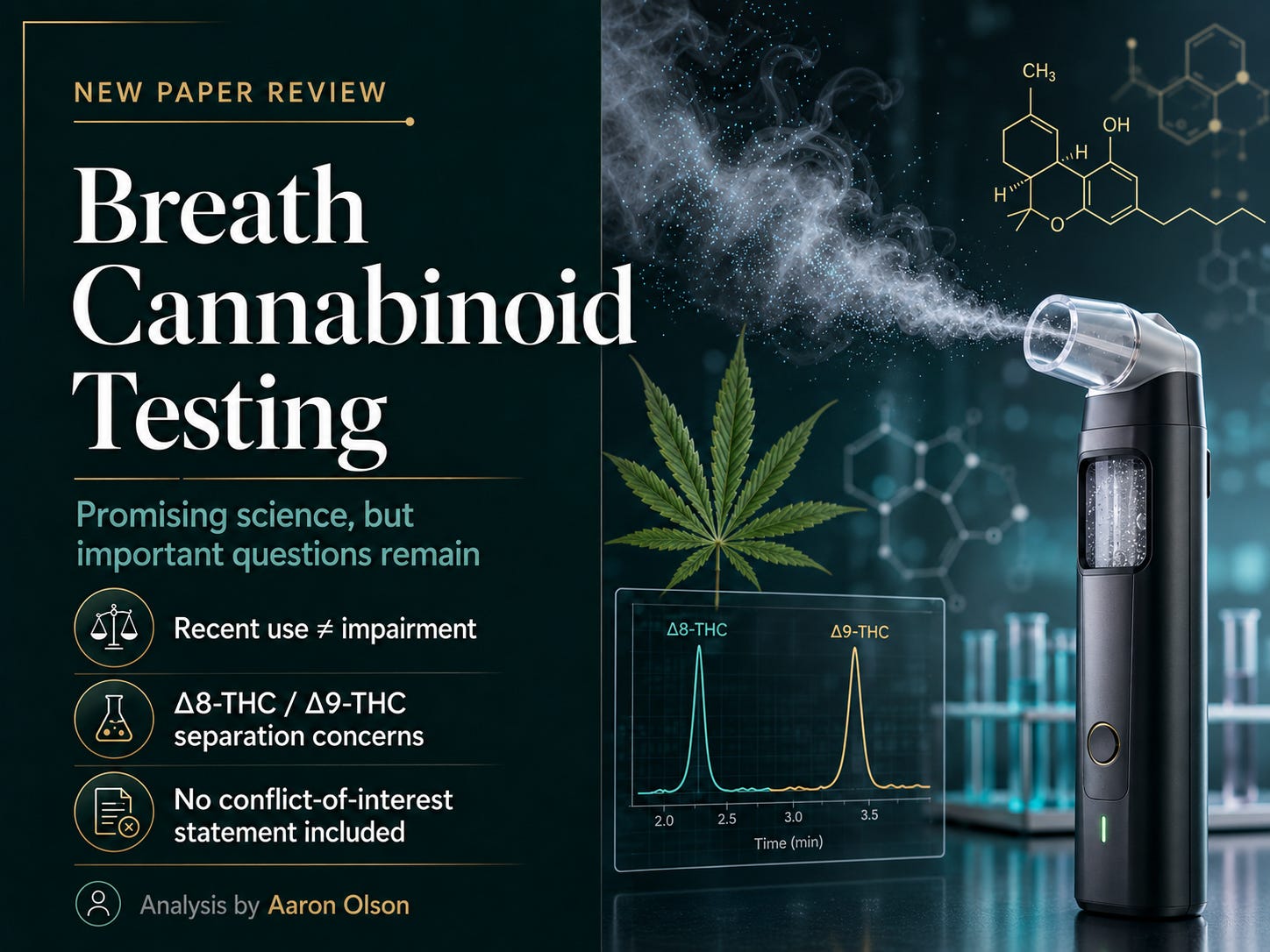
A recent paper in the Journal of Analytical Toxicology by Deeb and colleagues describes a method for the simultaneous analysis of Δ9-THC, Δ8-THC, CBD, and CBN in breath aerosol collected using the Cannabix Technologies Breath Collection Unit.
But here’s the problem: the authors opine about impairment, but they never measured impairment.
Detection of THC is not the same thing as impairment.
The impairment problem
The study of THC in breath did not include direct measurements of impairment.
There was no driving simulation, cognitive testing, psychomotor testing, divided-attention testing, or validated behavioral impairment assessment.
Yet the paper discusses breath cannabinoid testing in settings such as workplace testing and driving under the influence of drugs investigations.
That framing could easily lead readers, attorneys, judges, or policymakers to overinterpret the results.
I pointed out in my letter to the editor that the relationship between THC concentration and impairment is highly variable and dependent on multiple factors, including dose, potency (percent THC), route of administration, inhalation timing, and user tolerance.
In the largest randomized, double-blinded, placebo-controlled trial to date, Fitzgerald et al. reported that,
“THC concentrations (and/or metabolites/related cannabinoids) in blood, oral fluid, or breath cannot be used as a sole indicator of impairment,” and further that “there was no correlation between THC… in blood, oral fluid, or breath and driving performance”.1
This is not a minor distinction.
In forensic toxicology, the difference between “detected use” and “proved impairment” can determine how evidence is presented in court.
Study design limitations
In addition, important variables were not tightly controlled, including:
Dose consumed
Actual THC potency
Number of inhalations
Breath-hold duration
Total exposure
Individual tolerance
Each of these factors can influence cannabinoid concentrations.
Analytical separation of Δ8-THC and Δ9-THC
Another concern involves chromatographic resolution.
The paper reports a calculated resolution of Rs = 0.9 between Δ9-THC and Δ8-THC.
Yet, baseline resolution is generally understood to require Rs ≥ 1.5 to ensure accurate peak integration and reliable quantitation.
Incomplete separation can be especially important for distinguishing structurally similar cannabinoids such as Δ8-THC and Δ9-THC.
This is not just a theoretical concern.
Forensic toxicology has already seen real-world problems involving THC isomer separation and misidentification.
Conflict of interest and transparency
One additional issue deserves attention.
The paper's title specifically refers to the Cannabix Technologies Breath Collection Unit.
Two authors are affiliated with Cannabix Technologies Inc., and the funding statement says the work was funded by Omega Laboratories and Cannabix Technologies Inc.
The acknowledgments also thank the Cannabix Technologies team and a Cannabix consultant for support and review.
Despite that, I did not see a conflict of interest statement included with the paper.
That does not mean the work is invalid.
But disclosure matters. Readers should be able to clearly evaluate financial, professional, and institutional relationships that may be relevant to the work.
Takeaway
The paper is useful.
But the interpretation should remain narrow.
The study supports the possibility of detecting recent cannabis use in breath.
It does not establish that breath cannabinoid concentrations can determine impairment.
It does not show that a particular breath THC value corresponds to unsafe driving.
It does not resolve the analytical and interpretive challenges that continue to surround cannabis toxicology.
Breath testing for cannabinoids may eventually become an important tool. But in forensic contexts, the science has to be communicated carefully.
My full analysis of the paper is available here:
https://academic.oup.com/jat/advance-article/doi/10.1093/jat/bkag028/8671355
Fitzgerald RL, Umlauf A, Hubbard JA, et al. Driving Under the Influence of Cannabis: Impact of Combining Toxicology Testing with Field Sobriety Tests. Clin Chem 2023; 69: 724–733.