

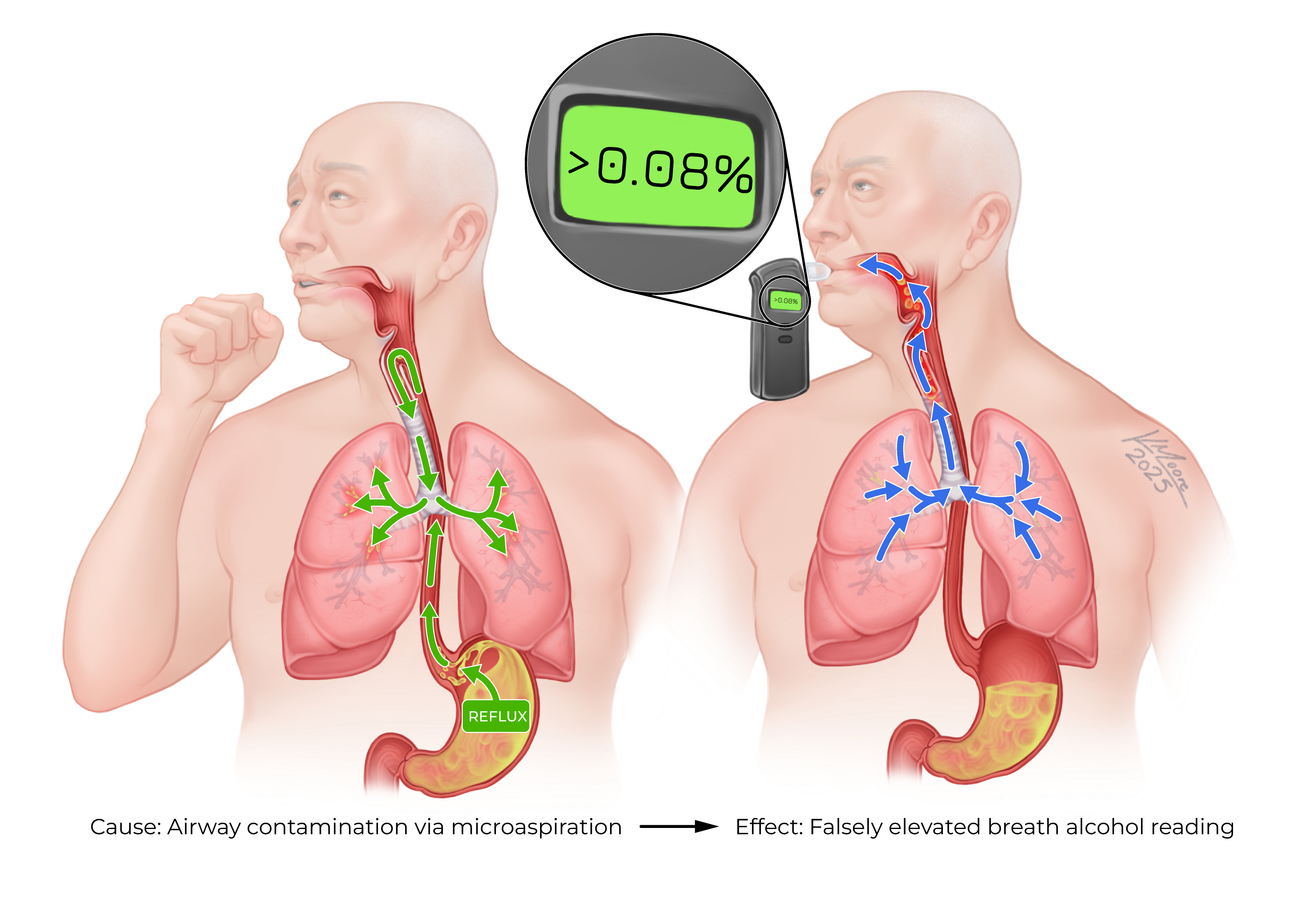
Breath alcohol testing depends on a basic assumption: contamination-free sampling.
The sample being measured must come from the breath, not from stomach alcohol or other sources.
That assumption is not always met.
My new paper in the Medico-Legal Journal, GERD-related microaspiration as a contaminant in breath alcohol testing: Case reports, discusses a potential mechanism of breath sample contamination that has not received enough attention: GERD-related microaspiration.
The GERD-Cough Relationship
GERD and chronic cough are often connected.
In some patients, refluxed gastric contents can reach the larynx, trachea, or airways through a process known as microaspiration. These events may be obvious, but they can also be subtle.
They may present as coughing, throat clearing, irritation, or airway symptoms rather than overt vomiting or regurgitation.
That distinction matters in breath alcohol testing.
Most breath testing protocols focus on preventing obvious contamination events.
Officers are trained to conduct an observation period before testing. The subject is not supposed to eat, drink, smoke, vomit, regurgitate, or burp.
Modern breath alcohol instruments also use slope detection algorithms and duplicate breath samples to help identify possible mouth alcohol contamination.
But what happens when the contaminating event is not obvious?
What happens when a person with GERD coughs or clears their throat shortly before providing a breath sample?
And what if that cough reflects reflux-related microaspiration of gastric contents that contain ethanol?
That is the issue explored in the paper.
The Case Reports
The article presents two case reports involving individuals with GERD-related medical histories, coughing near the time of breath testing, and breath alcohol expirograms showing negative slopes consistent with mouth alcohol contamination.
In the first case, the subject had a documented history of GERD, chronic cough, throat clearing, dysphagia, globus sensation, burning mouth symptoms, and a persistent acid taste.
During the observation period and testing sequence, video showed repeated coughing and throat clearing, including a coughing fit within seconds of breath sampling. The first test was reported as deficient because the breath alcohol slope did not level properly.
A second test produced a reported result of 0.14 g/210 L, but the expirogram showed a negative-going slope consistent with mouth alcohol contamination.
In the second case, the subject had chronic GERD and was prescribed omeprazole. The video showed coughing before both breath samples.
The reported result was 0.11 g/210 L, but the expirogram again showed a negative-going breath alcohol slope consistent with mouth alcohol contamination.
The Forensic Question
These cases raise an important forensic question: when GERD, coughing, and abnormal expirograms appear together, should the possibility of reflux-related contamination be considered?
I think the answer is yes.
Medical history, video, observation-period details, subject statements, coughing, throat clearing, and expirogram data matter.
Breath Testing Is Not Just a Number
Breath alcohol testing is often treated as a simple measurement. Blow into the instrument, get a number, and move on.
But the physiology behind breath testing is not so simple.
The human airway is not just a passive tube.
Reflux, coughing, throat clearing, airway irritation, and microaspiration can complicate the assumption that the breath sample is free from contamination.
The broader point is straightforward:
Breath alcohol results should not be reviewed in isolation.
They should be evaluated as part of the full scientific and factual record.
Full paper: https://journals.sagepub.com/doi/10.1177/00258172261442706