

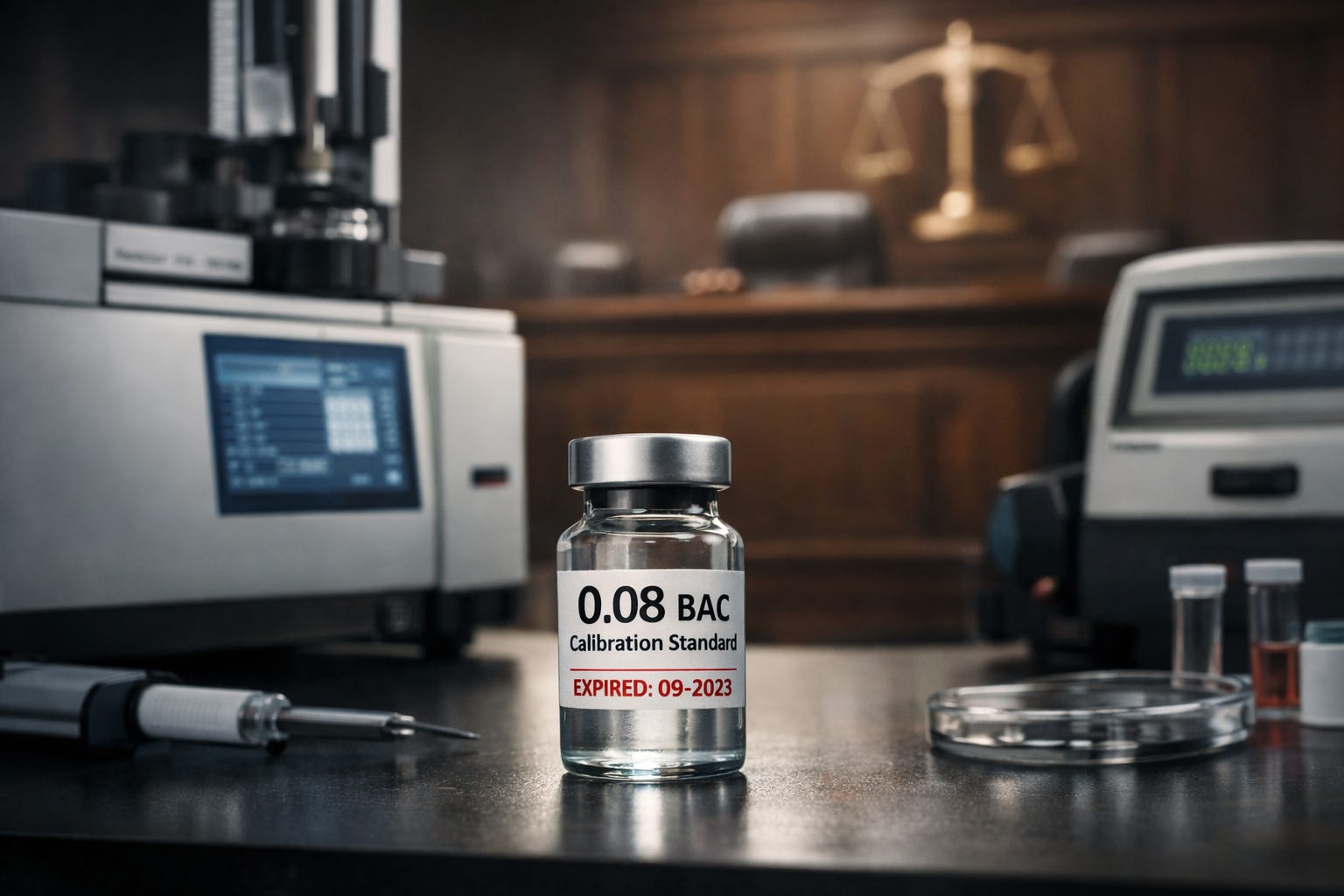
A recent impaired-driving case in Minnesota revealed that an expired calibrator was used in blood alcohol testing at the Midwest Regional Forensic Laboratory.
The issue was not identified through routine oversight or public disclosure. It surfaced only after an independent expert (me) requested additional records during the case review.
That discovery led Daniel Koewler and me to publish a new commentary in MinnPost showing why Minnesota needs independent oversight of its forensic laboratories.
The pattern behind the problem
The expired calibrator is not just a one-off issue. It fits into a broader pattern.
In 2025, a Minnesota veteran found himself fighting a DWI case over a urine alcohol result that had been rounded upward by laboratory software.
His measured value was 0.0799, below the legal threshold. But when the laboratory converted the result into statutory units, the software rounded the value up to 0.08.
In 2010, the Tri-County Regional Forensic Laboratory reported urine alcohol concentrations incorrectly because results were not converted into the statutory units required by Minnesota law. This caused alcohol concentrations to be reported higher than they should have been.
In 2011, the state also experienced the Intoxilyzer 5000 source-code controversy, in which a known software patch was not installed for years despite the defect having been identified. This error led to certain valid breath samples being rejected, exposing drivers to harsher refusal penalties.
Minnesota then spent roughly $1.7 million on the DataMaster DMT to replace the Intoxilyzer 5000. The BCA highlighted that the DMT had two methods of analysis: fuel cell and infrared technologies.
Yet one of those analytical components, the fuel cell, was turned off within months of deployment despite being touted as an important quality assurance safeguard.
In 2012, serious problems were uncovered at the St. Paul Police crime laboratory after a court challenge revealed that drug analysts were operating without written standard operating procedures or properly validated testing methods.
Independent reviewers later found major deficiencies in documentation, quality assurance practices, and analytical procedures. Drug testing at the lab was eventually suspended while the problems were investigated.
In 2025, a judge excluded DNA produced by the BCA in Minnesota v. Porter. The evidence generated was found not to be scientifically reliable.
And just last fall, we discovered problems involving dry-gas reference materials used to check breath-testing instruments. This discovery forced prosecutors to dismiss or reevaluate dozens of cases across the state.
Each of these issues may seem technical on the surface. But in forensic science, technical details are the foundation of reliability.
Why these issues matter
When those details are wrong, the consequences affect real cases, real people, and real outcomes in court.
What ties these events together is not just the errors themselves. It is how they are discovered.
Again and again, these problems come to light only after case-by-case scrutiny by defense attorneys and independent experts.
They are not identified through a system designed to catch and disclose them early.
We need forensic oversight
At least 18 states now have forensic science oversight boards or commissions that provide independent review of forensic laboratories and investigate scientific failures.
In 2025, those efforts became more coordinated through the creation of the National Association of Forensic Science Boards.
Minnesota does not currently have anything comparable.
What oversight is really about
The purpose of an oversight is to ensure public labs are doing good science and to investigate errors in the system.
Most forensic scientists are doing careful and professional work under difficult conditions. The issue is the system.
Oversight is about creating a structure that identifies errors early, reviews them independently, and discloses them transparently.
That is how scientific disciplines maintain credibility.
Where Minnesota stands
Right now, Minnesota relies heavily on litigation to surface problems that should be visible through routine quality assurance and public reporting.
That is not an efficient or reliable way to safeguard scientific integrity.
If forensic science is going to carry the weight it does in criminal court, it needs to operate with the same level of openness and accountability expected in other areas of science.
Read the full article here: https://www.minnpost.com/community-voices/2026/03/minnesota-needs-independent-oversight-of-forensic-labs/