

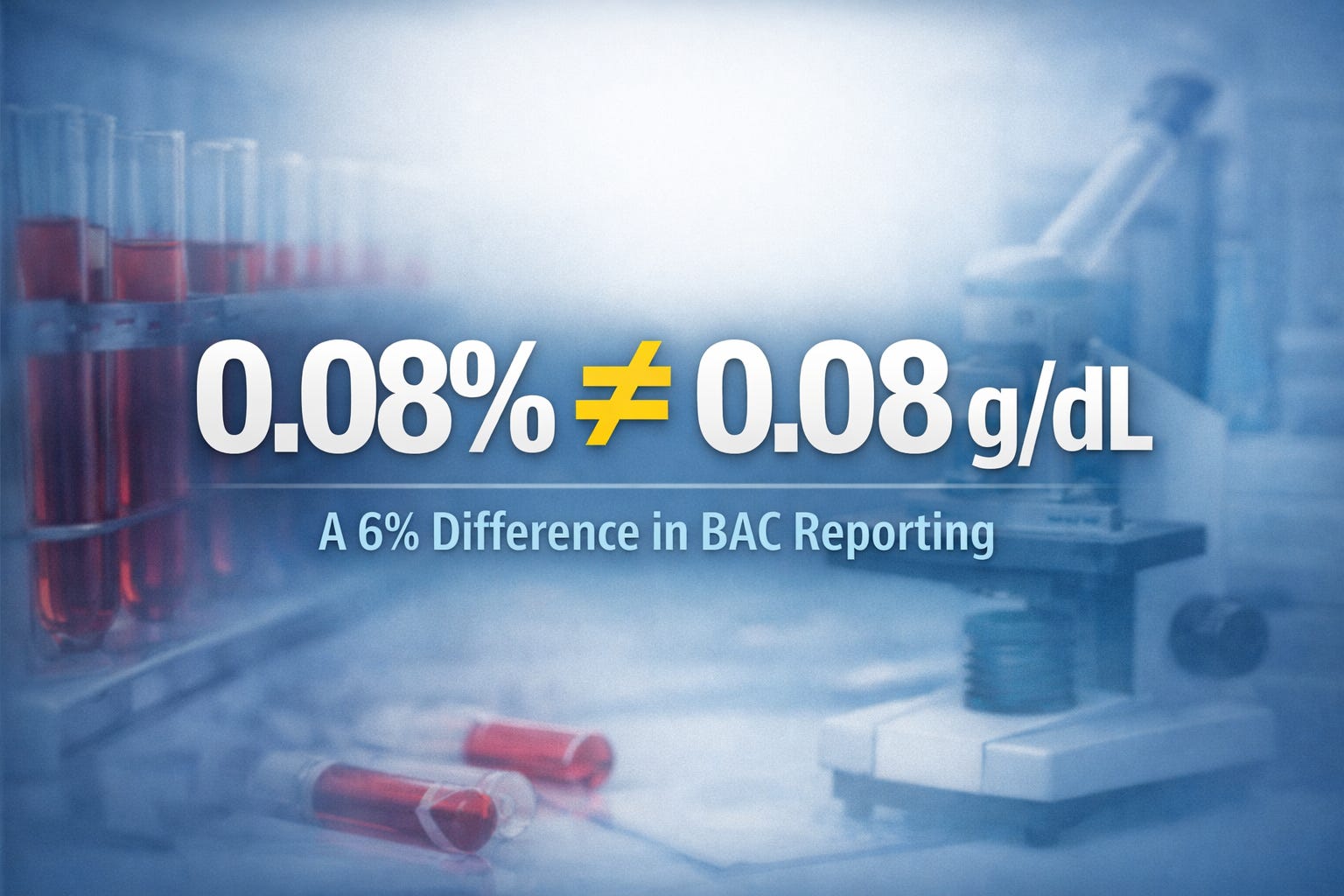
I’m excited to share a new paper of mine that was just published in Forensic Science International: Synergy: Unit inconsistency in forensic blood and breath alcohol reporting.
This paper addresses a simple but important issue that has real implications in forensic toxicology.
In many U.S. jurisdictions, such as South Dakota, Massachusetts, and New York, statutes define blood alcohol concentration (BAC) as percent by weight (a mass/mass unit). Modern laboratories, however, measure and report BAC in grams per deciliter (g/dL), a mass/volume unit.
These units are often treated as interchangeable.
They are not.
Because whole blood has a density of approximately 1.055–1.06 g/mL, a value reported in g/dL will be numerically higher than the equivalent percent by weight value.
What does that mean in practice?
A reported BAC of:
0.080 g/dL
when converted to percent by weight becomes:
0.080 g/100 mL ÷ 1.06 g/mL × 100 ≈ 0.075% by weight
That’s about a 6% difference.
In jurisdictions where the statute defines BAC as percent by weight, but laboratories report values in g/dL without reconciling units, this results in systematic overreporting of BAC by approximately 6%.
This extends to breath alcohol as well
Some jurisdictions, such as New York and Massachusetts, do not report breath results directly in g/210 L, but instead express breath alcohol as an equivalent %BAC by weight.
In these cases, the conversion from breath to blood is performed, but the final value is still treated as percent by weight without reconciling the underlying mass/volume units.
Breath alcohol is typically measured as:
0.08 g/210 L (mass/volume)
Assuming the standard 2100:1 blood-to-breath ratio,
0.08g/210 L (breath) corresponds to 0.08g/100 mL (blood)
But that is still a mass/volume value.
Converting to percent by weight:
0.08 g/100 mL ÷ 1.06 g/mL × 100 ≈ 0.075% by weight
The same ~6% difference carries through.
Bottom line
This is not a problem with instrumentation.
It is not a calibration issue.
It is a unit reconciliation issue.
My paper walks through:
how mass/mass and mass/volume differ in whole blood
and how this discrepancy carries through both blood and breath alcohol reporting
My goal was to clarify how unit definitions affect interpretation, particularly when comparing laboratory results to statutory BAC thresholds expressed as percentages by weight.
If you work in forensic toxicology, this is a reminder that how we define the measurand can determine how we interpret results.